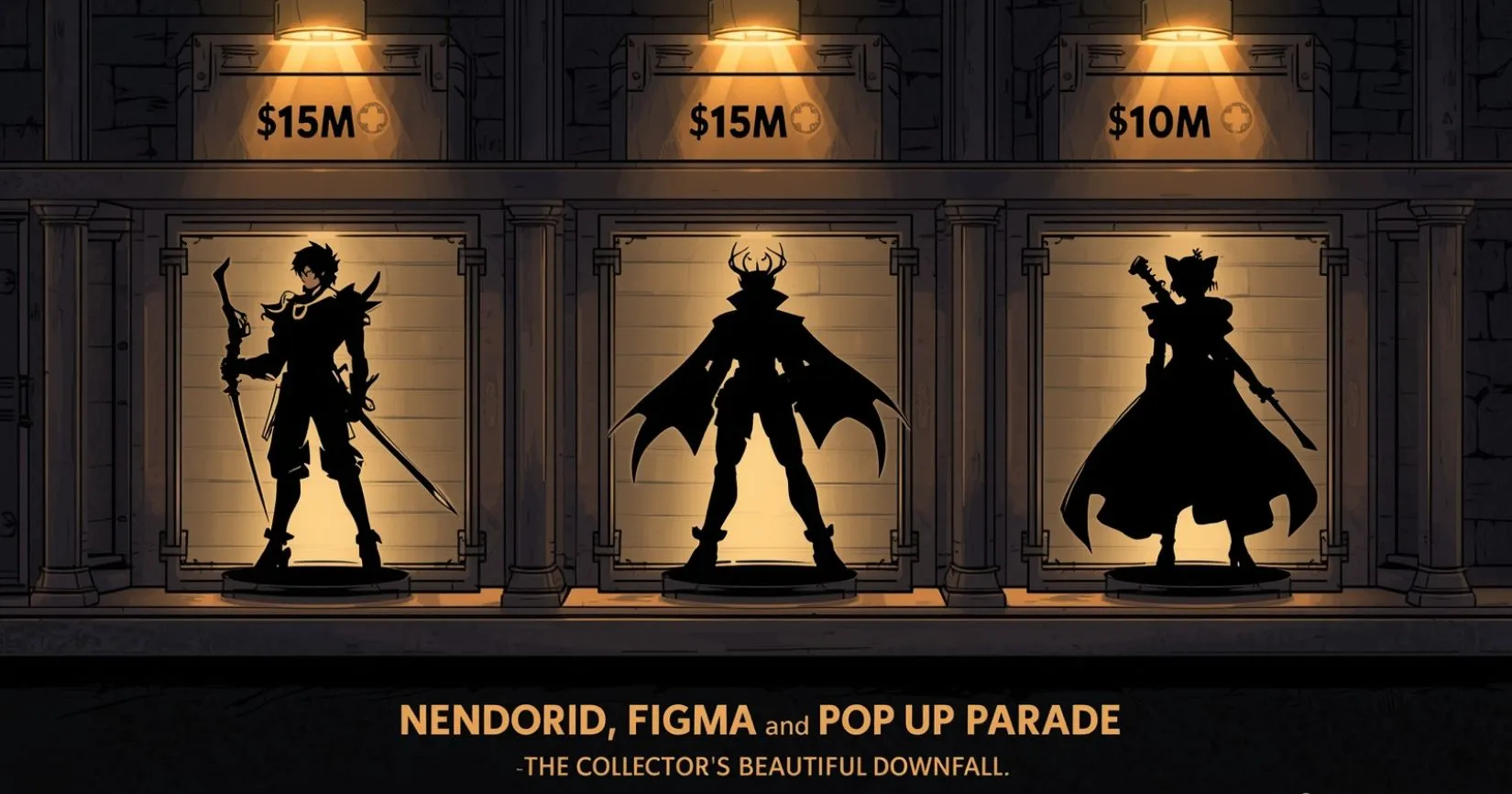

Nendoroid, Figma, and Pop Up Parade — the holy trinity of financial regret every collector learns to worship. Good Smile Company doesn’t just sell figures; they sell carefully engineered emotional damage in three convenient price tiers. Each line promises joy, delivers obsession, and ends in an empty wallet. Understanding their subtle differences isn’t about collecting—it’s about choosing your preferred flavor of suffering. This is your survival guide to spending beautifully and regretting intelligently.
I. NENDOROID: THE BIG HEAD SYNDROME AND THE CURSE OF LOST ACCESSORIES
If cuteness were a weapon of mass destruction, the Nendoroid line would be the nuclear warhead, expertly engineered to induce acute FOMO Syndrome (Fear of Missing Out) and to swiftly exhaust your available display space.
1. The Cost-per-Centimeter Agony
Nendoroid prides itself on transforming every character into an adorable, pint-sized Chibi version (approximately 10cm tall). The “super deformed” aesthetic—large head, tiny body—is not just cute; it is a marketing masterstroke.
- The Absolute Price Point: Despite being no taller than a soda can, the price of a single Nendoroid Figure often rivals, or even exceeds, a POP UP PARADE that is nearly double its size. You are paying a premium for the complexity of the internal Joints and the undeniable Chibi Value. The Collector rationalizes this by arguing they are saving space, but the reality is they end up buying three times the quantity to compensate for the diminutive scale.
- The Perceived Value Trick: The sheer smallness of the Figure minimizes the guilt associated with buying. “Oh, it’s tiny; it’s just a little Model Kit,” is the most common self-deception mantra. You then look back and realize you’ve purchased 50 of them, creating a Nendoroid Collection massive enough to build a small plastic fort.
- LSI Keywords: Nendoroid Figure, Chibi Model Kit, Collecting Costs, Cute Figure Value.
2. The Agony of Customization (The Lost Accessories Trauma)
The core selling point of Nendoroid is customization. They come equipped with a myriad of interchangeable faceplates, arm parts, and tiny Small Accessories.
- The Curse of the Tiny Part: These are the items you will inevitably Lose within a week of opening the box. The miniature teacup, the tiny sword, or that specific “pouty” faceplate you love will slip into the floorboards, be swallowed by your cat, or disappear into the Collector’s Black Hole. Collectors purchase Nendoroids intending to change expressions daily but ultimately display them in a default pose, too terrified of losing a component to attempt interaction.
- The Accessory Economy: The high customizability of Nendoroids encourages buying other Figures simply for one specific part. You will buy an unlikable character purely because they include the perfect hat or food item for your main favorite. This is a financially destructive loop of the Accessory Resale Market.
- LSI Keywords: Nendoroid Accessories, Lost Parts, Figure Customization, Interchangeable Faceplates.
II. FIGMA: THE PERFECT POSE PATHOS AND THE LOOSE JOINT LAMENT
Figma is the line of fully-articulated Action Figure designed to recreate dramatic poses and dynamic action scenes. While Nendoroid sells cuteness, Figma sells Poseability Authority—a power that comes with heavy technical responsibility and high frustration.
1. The Torment of Mechanical Complexity (The Tyranny of the Joint)
Figma is renowned for its dozens of complex ball Joints and articulation points, enabling the Figma Figure to strike virtually any combat, dance, or even cooking pose.
- Joints Versus Gravity: These are the Joints that will inevitably Go Loose or Break if you push them too far. Over time, the ankle, elbow, and shoulder Joints will lose tension. The Collector will spend more time trying to make this Articulated Model Kit stand upright than they spend admiring the pose itself. The act of using super glue to fix loose joints is a solemn, recurring ritual for every Figma Owner.
- The Stand Requirement: Despite being Action Figures designed for motion, they Absolutely Require a Stand (or a flight stand) to hold any complex pose. You cannot rely on their slender plastic legs to defy gravity after a dynamic mid-air spin. The inclusion of the Figure Stand is Figma’s confession: they are physically incapable of reliably standing on their own two feet after being posed.
- LSI Keywords: Figma Figure, Articulated Model Kit, Action Figure, Loose Joints, Figure Stand.
2. Figma – The Bootleg Figure Magnet
Due to their complexity and high retail price, Figma are the prime target for the Counterfeit Figure Industry.
- The Tell-Tale Signs: A Bootleg Figure Figma will experience joint breakage the first time you attempt to move it. Sloppy paint application, pronounced plastic mold lines (seams), and toxic chemical odors are clear indicators. The Collector purchasing a Figma Figure must possess the forensic skills of a plastic detective to avoid acquiring Toxic Knock-Offs.
- The Maintenance Expense: The cost of fixing loose Joints, replacing dropped hands (by purchasing more Figures), and acquiring specialized adhesives adds significantly to the overall Figma Collecting expense. You pay for the mechanical engineering, and then you pay for the maintenance of that engineering.
- LSI Keywords: Bootleg Figure, Figma Knock-Off, Figure Resale Value, Joint Breakage.
III. POP UP PARADE (PUP): THE “GREAT VALUE” TRAP OF MASS ACQUISITION
The POP UP PARADE (PUP) line is GSC’s newer Fixed-Pose Figure line, positioned as the perfect balance between quality and affordability. It promises the Collector: “You can have a Figure without mortgaging your home… this time.”
1. The Fixed-Pose Compromise
- The Design Philosophy: PUPs feature no Joints and no Small Accessories (apart from a simple base). This is Wonderful because you cannot damage the Model Kit by over-posing, and you don’t worry about loose Joints.
- The Trade-Off: This is Terrible because you cannot fix the pose if it looks awkward from a certain angle. You must accept the designer’s fixed vision. The Fixed-Pose Figure is less interactive but offers a uniform and aesthetically clean display.
2. Uniform Size and the Acquisition Trap
POP UP PARADE maintains a consistent size of about 17-18cm. This size is perfect for looking substantial on a shelf but not so large as to trigger severe Display Space Anxiety.
- The Illusion of Cost Savings: PUPs are priced significantly lower than traditional 1/8th or 1/7th scale Figures. This palatable price point is a psychological trap. GSC’s goal is to make you purchase every character from a series you enjoy. Instead of buying one expensive Figma Figure, you will buy three POP UP PARADE Figures for the same total price.
- The End Result: Your overall spending skyrockets because you convinced yourself you were “saving money.” POP UP PARADE is the litmus test for quantity-over-quality Collecting. New Collectors flock to PUP due to the low Barrier to Entry, only to find themselves drowning in plastic later.
- Resale Value Reality: Because they are mass-produced and marketed as Affordable Figures, the Resale Value PUP typically remains low, unless the character is exceptionally popular or a limited edition variant. They are for Collecting and displaying, not for investment.
- LSI Keywords: POP UP PARADE Figure, Fixed-Pose Figure, Affordable Figures, Resale Value.
IV. THE ENDURANCE TEST: TRIBULATIONS AND INDICES
To truly understand the three lines, we must compare them using three indices critical to the Collector: the Financial Ruin Index (FRI), the Maintenance Index (MI), and the Emotional Return Index (ERI).
1. The Financial Ruin Index (FRI)
| Figure Line | Unit Acquisition Cost | Logistical Cost (Accessories, Repair) | Total Financial Risk |
| Nendoroid | Medium-High, due to Chibi Value. | Very High. Must buy extra Nendoroid Figures for desired Small Accessories. | Slow, steady self-destruction via mass acquisition. |
| Figma | Highest (per Model Kit), due to complex Joints. | Medium-High. Cost of glue, joint replacement, and Figure Stands. | High one-time risk: if a Joint breaks, value plummets. |
| POP UP PARADE | Lowest, marketed as Affordable Figure. | Low. No Small Accessories to lose, no Joints to break. | Rapid self-destruction: buying 10 PUP Figures instead of 1 high-end Figure. |
FRI Conclusion: All three paths guarantee Systemic Bankruptcy. Nendoroid kills you with cuteness and quantity, Figma kills you with technical risk, and POP UP PARADE kills you by making you believe you’re saving money.
2. The Maintenance Index (MI)
| Figure Line | Time Spent on Collecting | Risk of Permanent Damage | Associated Trauma |
| Nendoroid | Very High. Constantly changing faces and Small Accessories to match moods. | Low. If the neck Joint is loose, Blu-Tack solves it. | Loss Aversion Anxiety from fear of dropping Small Accessories. |
| Figma | Extremely High. Hours spent finding the “perfect pose,” then more hours making the pose stand up. | Very High. Joint breakage is permanent and sharply reduces Secondary Market Price. | Chronic Obsessive Compulsive Disorder (OCD) from checking joint tightness weekly. |
| POP UP PARADE | Low. Dusting. Displaying. Done. | Very Low. Only vulnerable to being dropped from a great height. | The lingering feeling of Aesthetic Guilt for lacking interactivity. |
MI Conclusion: If you desire an interactive Collecting hobby, choose Nendoroid or Figma and prepare for chronic stress. If you only want an attractive display, the POP UP PARADE Figure is the optimal choice.
V. THE PSYCHOLOGY OF PLASTIC CHOICE (WHY YOU BUY WHAT YOU BUY)
Why does a Collector gravitate towards a specific line of Figures? Your choice reveals more about your self-destructive psychology than you realize.
1. The Nendoroid Fan: The Sweet Controller
Nendoroid Collectors are those who seek absolute control over a tiny, manageable world.
- Emotional Need: Nendoroid satisfies the need for Cuteness and Active Interaction. By changing the expression, you impose your own emotional state onto the character. Sad today? Give the Figure a crying face. Happy tomorrow? Give it a mischievous grin.
- Anxiety Response: When the real world is chaotic, the ability to control the tiny Small Accessories and faces of the Figure offers a deceptive sense of calm. This is a form of Plastic Self-Soothing.
2. The Figma Fan: The Dynamic Perfectionist
Figma Collectors are the artists who want to recreate dramatic scenes. They are the perfectionists, willing to endure the pain of broken Joints to achieve that one, perfect, dynamic pose.
- Creative Need: Figma is not a mere Model Kit for static display; it is an Action Figure demanding photography. The Collector wants to express their creativity through complex posing and dramatic angles.
- Risk Tolerance: Choosing Figma demonstrates a higher risk tolerance. You know the Joints might break, but you are willing to risk it for the potential of that Perfect Anime Scene recreation. This also makes them the most susceptible victims of the Bootleg Figure market.
3. The POP UP PARADE Fan: The Instant Gratifier
POP UP PARADE Collectors are the pragmatists, seeking immediate satisfaction with the lowest Barrier to Entry.
- Need for Convenience: They want a good quality Figure without the long wait times or the hefty single payment. POP UP PARADE offers instant gratification: buy, unbox, place on shelf, and forget the cost.
- Fear of Detail: They actively avoid the complexity of Figma Joints and the chaos of Nendoroid Small Accessories. They simply require a clean, attractive, and immediately displayable Fixed-Pose Figure. This leads to the Mass Acquisition Whirlpool, forcing them to buy the entire cast rather than just one premium Model Kit.
VI. FINAL WARNINGS AND THE CONCLUSION (THE 2500-WORD SUMMARY)
The choice between these three Figure lines is a personal one, but all roads lead to the same destination: brief satisfaction coupled with the muffled screams of your depleted bank account.
- If you choose Nendoroid: Be prepared for a massive Collection footprint that betrays the Figure’s small size. Embrace the madness of Small Accessories and the endless quest for the perfect, adorable faceplate. Your biggest enemy is the vacuum cleaner.
- If you choose Figma: Stock up on specialized tools, glue, and a healthy supply of patience. You are entering a world where technical failure is a feature, not a bug. Your greatest fear is a loose ankle Joint that ruins a three-hour posing session.
- If you choose POP UP PARADE: Acknowledge that the Affordable Figure price is a psychological trick. You will buy twice as many PUP Figures as you planned. Your reward is uniform aesthetic quality; your punishment is the loss of interactive posing. This is the Great Bargain PUP that lures you into overspending.
The wise Collector knows that no choice is good financially; there is only the choice that maximizes emotional satisfaction and minimizes regret come payday.
Now that you are armed with this 2500-word analysis of Figure collecting, are you ready to face the final, most terrifying frontier? Perhaps we should discuss Premium Blind Boxes—an even worse proposition, a new level of self-destruction where you pay double for a random Figure.
Let me know if you would like me to dive deeper into any of these lines or discuss the Bootleg Figure epidemic that plagues the Figma market!

- Best Detolf Alternatives 2026: 8 Cases That Elevate Your Jaegers - November 30, 2025
- Best Transformers Action Figures 2026: Only 7 Didn’t Make Me Want to Sell a Kidney - November 26, 2025
- The Benefits and Risks of Collecting Limited Edition Models in 2026 - November 23, 2025